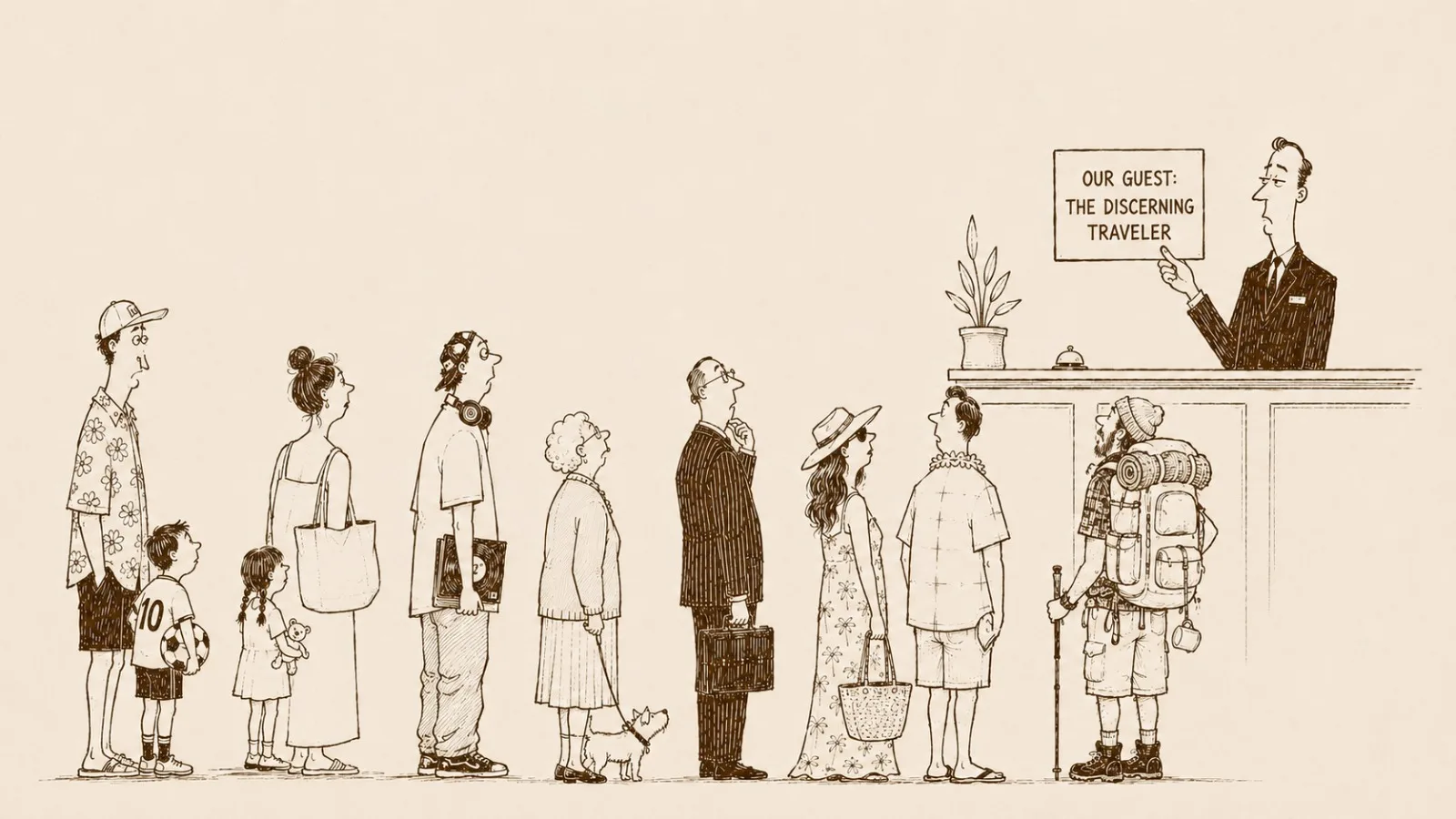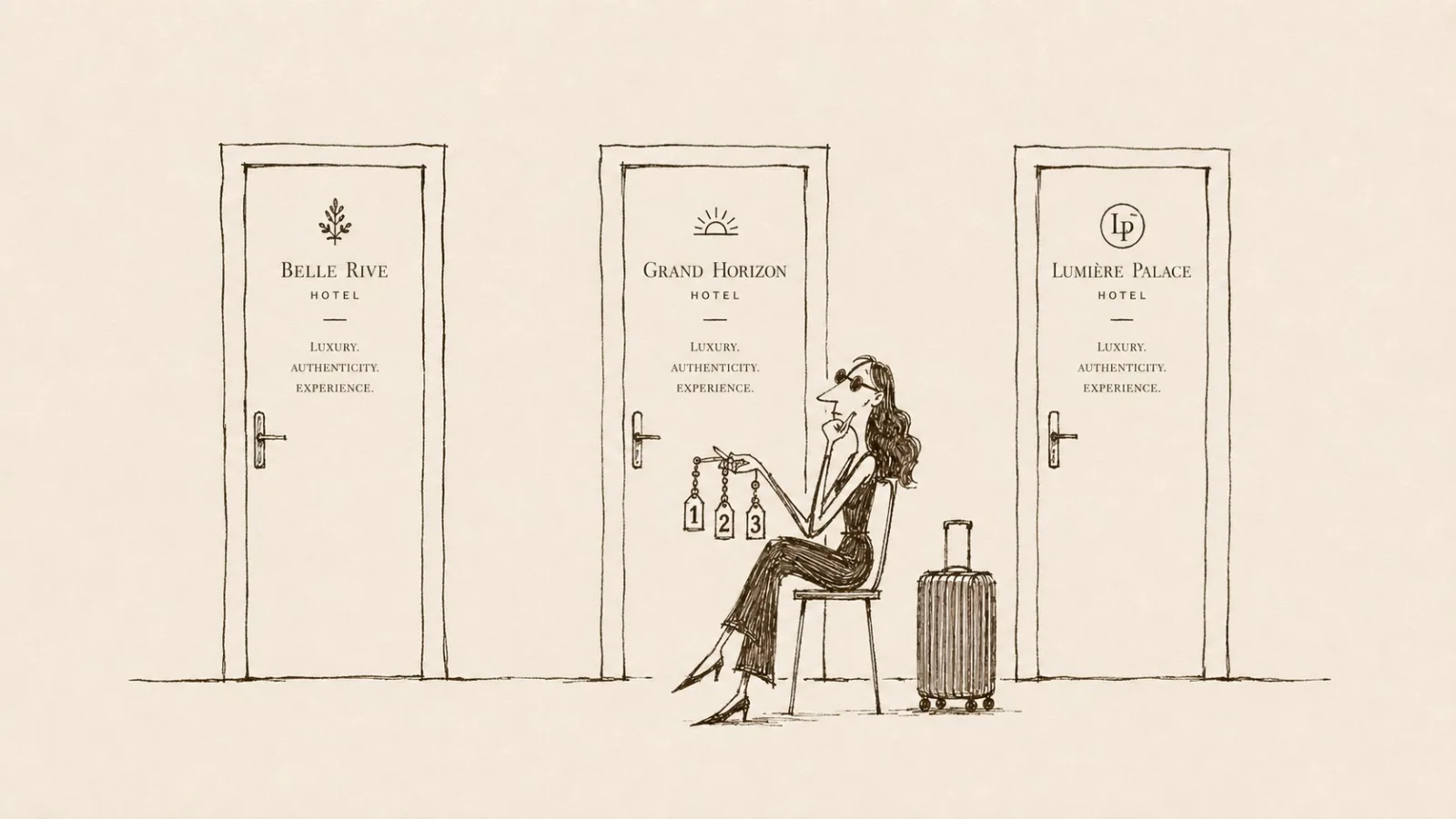
We read a lot of hotel brand decks. Most describe "discerning travelers who value quality and authentic experiences." That phrase fits every hotel we've ever looked at, which means it tells a guest nothing. We've watched what happens after a phrase like that goes live. An AI assistant gets asked for a recommendation, pulls from your pages and your reviews and whatever listing data exists, and turns it into whichever pattern shows up most often. Vague language flattens into an answer nobody remembers. This is how the retrieval mechanics work.
The trap of being liked by everyone
Ask a hotel marketing leader who their guest is, and watch the hesitation. That pause tells you more than whatever answer follows it. A brand built to offend nobody rarely gets chosen first, and it's the kind of thing a friend, or a language model, struggles to recommend with any confidence.
Broad positioning has always cost hotels word of mouth. What's different now is the recommender. AI discovery rewards precision the same way a well-traveled friend does: give it a sharp, repeatable answer about what a place is and who it suits, and it can repeat that answer accurately to the next person who asks. Stay safely upscale in every direction, offer nothing sharp enough to quote, and a retrieval system has nothing to work with. A hotel willing to be judged on a real point of view hands it a sentence instead.
What distinctive positioning actually looks like
Take two hotels that never tried to be liked by everyone. One built its entire promise around behaving like a private home rather than a hotel: help yourself to the kitchen, eat dinner at one shared table, forget the front desk exists. The other built a different kind of specificity: a named audience, a stated trade-off (small rooms, no concierge, no room service, in exchange for design and location), and a phrase repeated so consistently across its own materials and third-party coverage that the pattern became impossible to miss.
A stranger looking at either hotel gets something to hold onto: a specific, evidenced claim rather than an adjective to admire. Not a louder pitch. A provable one, narrow enough that a retrieval system can quote it back accurately.
Five disciplines for a brand AI can recognize
Skipping brand strategy used to be a minor inefficiency. Now it costs more, and it exposes every hotel that was coasting on a nice photo and a vague adjective. Five disciplines make the difference.
Understand the guest as motivations, not a demographic. Age and income explain little about why someone books. What matters is the occasion (an anniversary, recovery from a hard year, a work trip disguised as a break), the constraints they're managing, the outcome they actually want, and the criteria they use to choose between you and the next option. One brand skipped "young professionals" entirely and described travelers who cared more about design and location than a big room or a concierge they'd never use.
Choose a point of view and let it cost you something. A real belief about hospitality forces real trade-offs. The other hotel believed hospitality should feel like being a guest in someone's home, so it gave up the anonymity most hotels sell: communal dinners, a shared kitchen, twelve rooms instead of two hundred. A point of view that hasn't cost you a guest segment, a room type, or a service standard is probably a slogan.
Turn the point of view into a distinctive promise. This is where belief turns into something usable. Give a staff member a named ritual they can actually perform on an ordinary Tuesday, not a mission line. "Personalized service" means nothing until you name the ritual, the amenity, the house rule you're willing to say out loud.
Prove it with an evidence map, not adjectives. A warning here: this is the step where most brand work quietly falls apart. A promise with no proof behind it is just a sentence you're hoping people believe. Every claim needs a place it lives: the room page that names the detail, a photograph that shows the thing instead of a generic exterior at dusk, a review that confirms it independently, a press mention, listing data a system can actually retrieve. A strong evidence map changes how consistently and accurately a hotel gets described, though booking intent still depends on price, availability, and timing. What evidence changes is whether the hotel shows up correctly in the moments that build that intent. We hand clients findings: a claim with a source attached. A chart nobody can act on isn't evidence of anything.
Make it legible everywhere without flattening it. Your website, Google Business Profile, press kit, and OTA listing should describe the same hotel in the same terms. Too often five people write five slightly different versions without ever talking to each other. Legibility means consistency of fact and phrasing across surfaces, and it still sounds like you. The most retrievable brands tend to be the most specific ones, because specificity repeats accurately and enthusiasm doesn't.
A simple test, and a verdict
Try this before your next brand review. Hand a colleague outside marketing one sentence to finish: "This hotel is for people who want ___, and it's different because ___." Watch them hesitate, and know that an AI system summarizing your website hesitates the same way, just with better manners.
Here's our verdict. The hotels vanishing into AI's compression usually chose safety over a decision. Somewhere along the way they stopped being willing to lose the wrong guest in order to keep the right one. Fix the sentence. Put evidence behind it everywhere it needs to live. Then put it in front of us for a human read before it goes anywhere, because nothing worth being known for should go live unread.