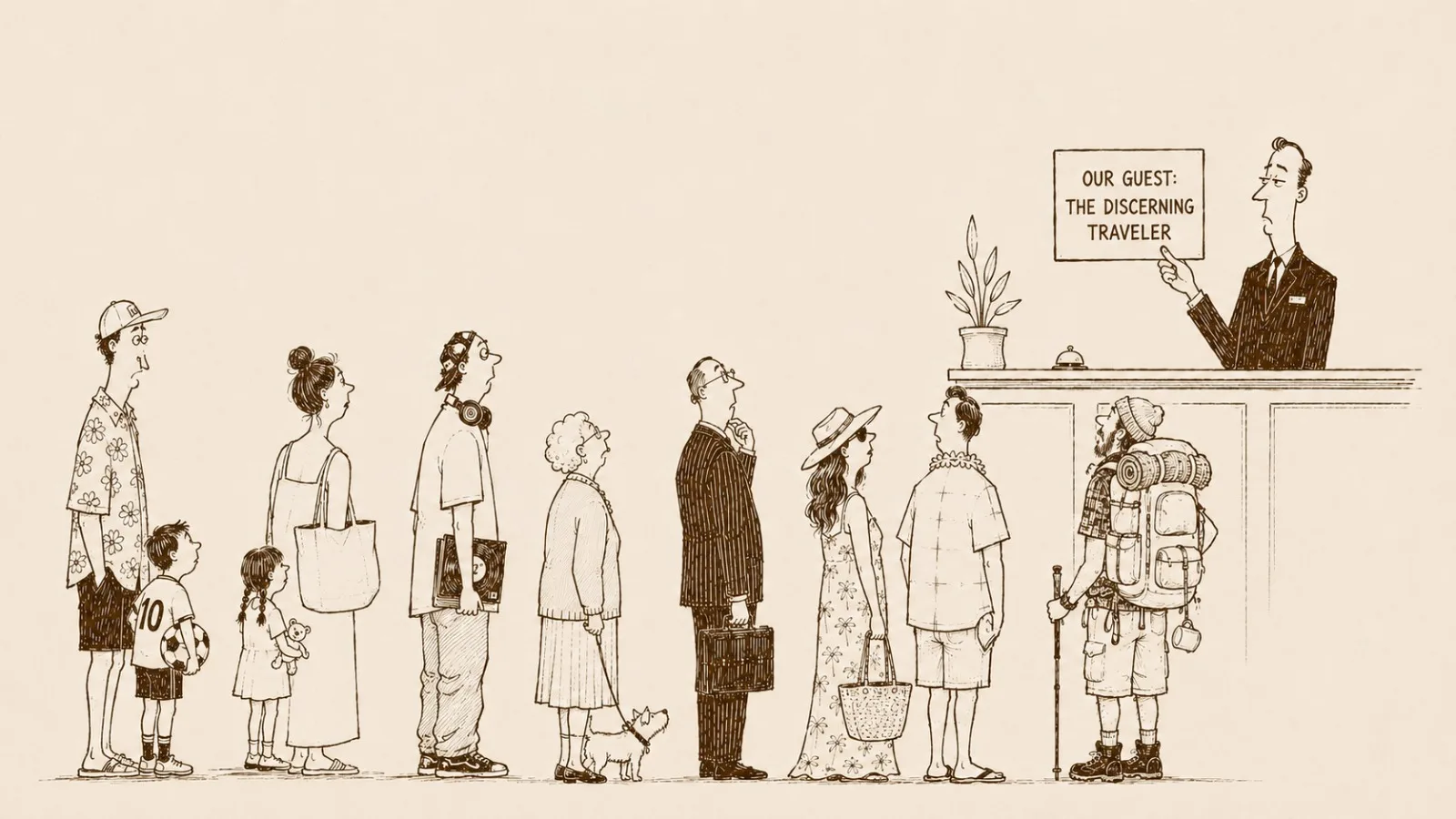
You open ChatGPT and ask for a week in Portugal. Minutes later, you have a shortlist of towns, a rough itinerary, and a handful of hotel names you had never heard of that morning. Then you close the chat, open a browser, and start checking those names against Booking.com, Google, and the hotel's own website before you book anything.
That sequence, not a single dramatic leap from question to confirmation, is what the AI-mediated travel journey actually looks like today. The funnel has not disappeared. It has compressed at the front and stayed remarkably intact at the back.
The new front door to travel
Generative AI has become a real starting point for trip planning, and the shift has moved quickly. 56% of U.S. travelers used AI for travel planning, booking, or in-destination assistance in the past 12 months, up from 43% in the second half of 2025 and 33% in the first half. Growth has broadened beyond early adopters too: millennials lead the way, with 74% using AI for at least one trip in the past year, followed by 72% of Gen Z, and usage climbed sharply across every generation, including a notable jump among boomers.
The habit is sticking because it works for the job you're giving it. At least 78% of travelers found GenAI results to be somewhat or very helpful for both planning and in-destination use. But helpfulness at the idea stage is not the same as trust at the transaction stage, and that distinction is the thread running through every stage of this journey.
From filters to intent
Search once meant filters: destination, dates, star rating, price band. AI planning tools work more conversationally. You describe a mood, a budget, or a constraint, and the system synthesizes options rather than returning a ranked list. Google's Canvas tool in AI Mode illustrates the shift directly: it gives you a space to organize plans and projects over time, customized for your specific needs.
This is a live capability, but a bounded one. Travel planning with Canvas is available on desktop in the U.S. for those opted into the AI Mode experiment in Labs. It is not yet the default way most people search. What it changes for hotels is upstream of the booking decision: the system is synthesizing your amenities, reviews, and positioning into a paragraph you read before you ever land on a website. If that synthesis is wrong, generic, or missing key facts, the hotel has lost ground before the comparison stage even starts.
Inventory, maps, reviews, and web evidence
When AI tools move from ideas to specific properties, they are pulling from a mix of sources: hotel websites, OTA listings, review platforms, and structured data feeds. Google has been explicit that this depends on partnership and data quality, not just crawling the open web. The company said it is already working with partners including Booking.com, Choice Hotels International, Expedia, IHG Hotels & Resorts, Marriott International and Wyndham Hotels & Resorts. For independent hotels outside those direct integrations, the evidence base is whatever is publicly findable and verifiable: accurate room descriptions, current pricing signals, and review content that corroborates what the hotel claims about itself.
This is the layer where a hotel's own site, its OTA listings, and third-party review volume either agree with each other or contradict each other. AI systems are increasingly built to cross-reference rather than take a single source at face value. A mismatch between what a hotel's website says and what its reviews describe is now a visibility problem, not just a reputation one.
The trust gap
The single most important finding for hotel marketing leaders is what Expedia Group calls the AI Trust Gap. It shows a clean split between where you form ideas and where you commit money. Expedia Group research shows that you're open to using AI chatbots and agents to help with planning a trip: 53% are comfortable letting AI suggest travel options, and nearly half (48%) say AI saves you time and helps you discover places you wouldn't have found otherwise.
That comfort evaporates at the point of purchase. The AI Trust Gap is most pronounced at the point of purchase, where you clearly favor trusted travel brands over AI booking tools: the majority, 68%, prefer to book with a trusted travel brand over AI chatbots and agents, even when AI booking is available. Expedia's own framing of the research is worth taking seriously here: you aren't interested in booking a trip through an AI chatbot, and what's holding you back isn't model quality or features, it's trust, which is built through real-world relationships and assets, strong customer support, and decades of deep industry knowledge.
You want AI as a research collaborator. You do not yet want it as the final word.
Booking.com's independent research lands on a similar structural point, if from the trust-in-AI-outputs angle rather than the brand-preference angle. 91% of respondents are excited about AI and 79% are familiar with it, yet only 6% express full trust in AI systems. And even among people using AI assistants for travel, while 89% want AI in future travel planning, only 12% are comfortable with it making decisions independently.
The booking handoff today
It's worth being precise about what "booking with AI" actually means right now, because the announcements have outpaced the transactions. OpenAI's Apps in ChatGPT let partners like Booking.com and Expedia surface interactive results inside a chat, but the transaction itself still happens on the partner's side. While purchases for travel still require handoff to the merchant, OpenAI's Stripe integration signals the potential for in-chat transactions in the future. OpenAI has since pulled back from building checkout into ChatGPT directly: the company is prioritizing making ChatGPT search and product discovery great, with the Agentic Commerce Protocol serving as infrastructure connecting users to merchants, with Instant Checkout moving to apps.
Google's ambitions point the same direction but aren't fully live for hotels yet. Google announced agentic flight and hotel booking for AI Mode in November 2025, but as of June 2026 it has not launched and there is no public release date, while agentic booking is already live in the U.S. for restaurants, event tickets, and appointments. The pattern across every major platform is consistent: AI does the research and narrows the field, then hands you to a merchant, an OTA, or the hotel's own booking engine to complete the transaction with human approval still in the loop.
What hotels must make verifiable and bookable
Given that pattern, three things matter more than any single platform integration.
Get the facts right everywhere they appear. AI systems synthesize across sources. If your website, OTA listings, and review profiles disagree on room counts, amenities, or policies, that inconsistency becomes a citation risk, not just a guest-experience risk.
Make your booking path unambiguous. Since large platforms carry the apps, what an individual hotel needs is to be listed on the platforms that do have apps and to have its own website content structured so AI tools surface it during the research phase. A clean, fast, accurately priced direct booking page still matters because it's often where you land after the AI-driven research phase.
Treat reviews as infrastructure, not just reputation. With comparison happening inside AI summaries before you ever see the site, review volume and specificity function as evidence the system can cite. Thin or contradictory review data weakens your position in exactly the synthesis step that determines whether you make the shortlist.
The in-trip loop
The journey doesn't end at booking. Once on the ground, you'll find translation tools and navigation help are the most common AI applications, with photo editing topping AI usage post-trip. This in-trip layer is a lower-stakes environment where you trust AI tools more readily because the financial commitment has already been made. It's a reminder that AI visibility isn't a single moment to optimize for. It shows up at inspiration, at comparison, and again once you've arrived, each time with a different trust threshold attached.
A decision framework for hotel commercial teams
Rather than chasing every new AI feature announcement, hotel marketing leaders can sort their priorities by where in this journey a given fact or asset actually gets used.
At the inspiration stage, ask: if an AI system had to summarize this hotel in two sentences, would it get the facts right, and would those facts be distinctive enough to make the shortlist? This is where editorial substance, specific named amenities, and clear positioning earn a citation instead of a generic mention.
At the verification stage, ask: do our website, OTA listings, and reviews agree with each other? Any traveler cross-checking an AI recommendation, and most still do, will notice gaps first.
At the handoff stage, ask: once a traveler decides to trust us, is the path to book fast, accurate, and free of friction? The trust gap research is a mandate to earn the booking once AI has done the narrowing, not a reason to deprioritize the booking engine itself.
None of this promises that AI visibility alone converts into direct demand. What the evidence supports is narrower and more useful: AI has become a legitimate front door for ideas, and the hotels that keep their information accurate, consistent, and evidenced across every surface are the ones still standing at the actual door when the traveler decides to walk through it.